Solutions
Bespoke Optimization and Decision-support Models
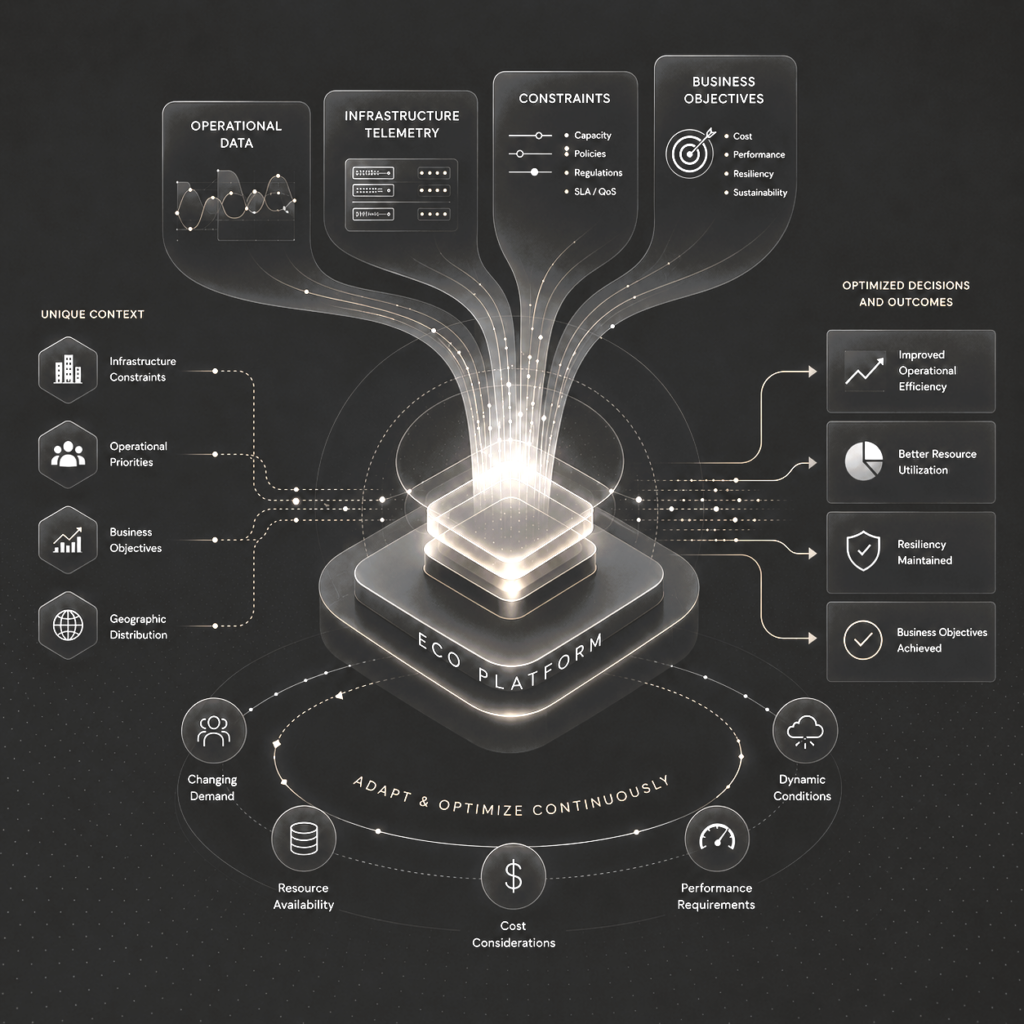
Optimization and Decision-support challenges are inherently context-dependent. Every organization operates with unique infrastructure constraints, operational priorities, business objectives, and characteristics. Effectively addressing these challenges therefore requires models that are tailored to the customer’s specific environment and can adapt to changing conditions.
The Arctos Labs ECO platform is designed with adaptability in mind. That makes it easy for us to support bespoke use cases across a variety of systems. Its flexible architecture enables customer-specific optimization and decision models that can incorporate large volumes of real-time operational data, dynamics, constraints, infrastructure telemetry, and business-driven objectives.
ECO is particularly well suited for environments where optimization and decisions must continuously adapt to changing demand patterns, resource availability, geographic distribution, cost considerations, or performance requirements. Through its unique design, the platform enables organizations to improve operational efficiency without sacrificing resiliency, quality, or resource utilization.
Organizations seeking to reduce inefficiencies, improve resource utilization, or increase operational automation can leverage a bespoke optimization and decision support solution for customer-specific optimization or decision support aligned with their technical and business objectives.
Data Centre Optimization
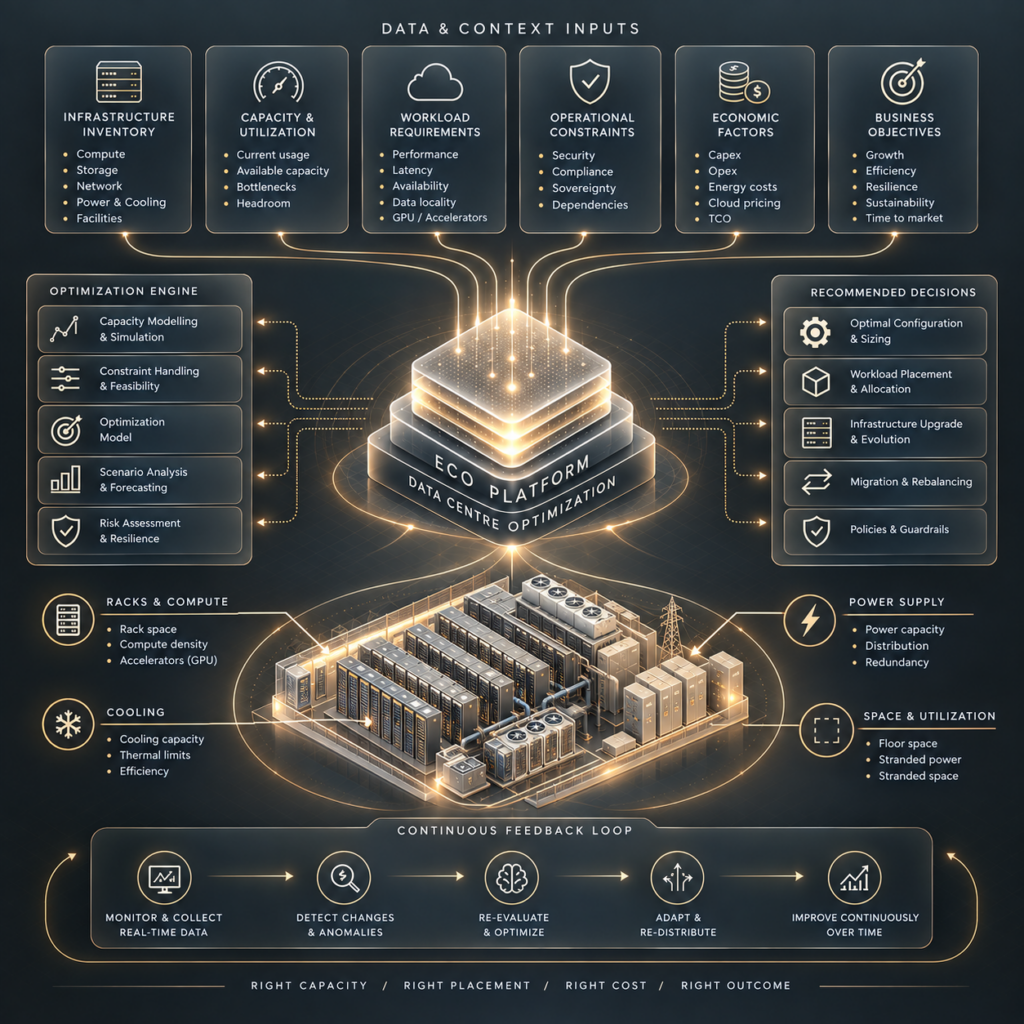
The growth of AI and other compute-intensive applications is driving higher infrastructure densities and placing new demands on power, cooling, networking and physical space. At the same time, data centre environments are becoming increasingly heterogeneous, combining different generations of servers, accelerators, storage systems, networking technologies, cooling architectures and distributed facilities.
These developments are changing the nature of data centre planning. Real data centre decisions rarely have a single objective.
Consider a rack placement decision.
- There might be rows that have available power, but limiting future POD placement and business flexibility if they are used
- There might be available spaces, but they might lead to stranded power.
- Available rows may not provide the lowest latency.
The technically optimal solution may therefore not be the economically optimal solution.
Arctos Labs ECO provides a framework for making these trade-offs explicit so the operator can explore:
”Which placement provides the best balance between cost, performance, capacity and resilience?”
This distinction becomes increasingly important as data centre environments become more constrained, and helps the operator meet business objectives.
Infrastructure Capacity Distribution
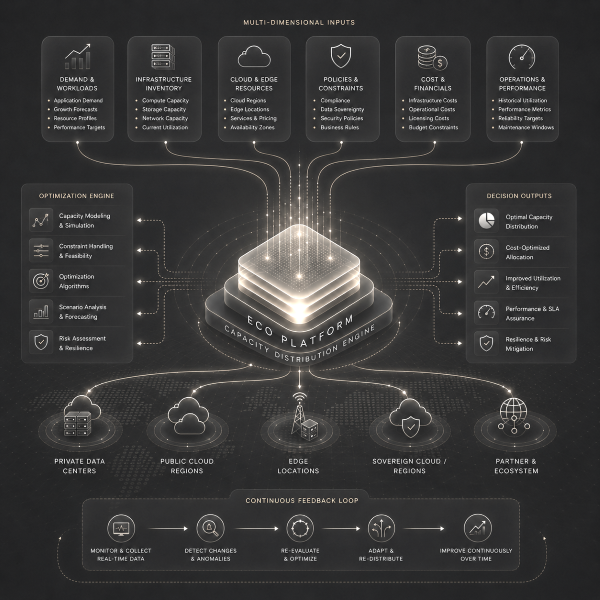
Many service providers and application owners depend on distributed delivery infrastructures to serve customers across multiple geographic regions. To ensure a consistent user experience, capacity must be available within an acceptable distance of the end users, whilst at the same time complying with legislation, having required certificates, providing needed capabilities, and achieving sovereignty if that is required.
Determining the optimal set of delivery locations — and the right amount of capacity at each site — is a complex challenge. To ensure wanted Quality of Service, organizations often respond by overprovisioning infrastructure, leading to unnecessary costs and inefficiencies.
Capacity distribution needs to be analysed under many different scenarios to ensure a robust application delivery, including the ability to shift application load between different delivery locations.
To address this, Arctos Labs has developed an advanced solution, based on the Arctos Labs ECO platform, for optimizing infrastructure capacity distribution.
The solution uses various usage patterns as input and evaluates factors such as:
- geographic demand distribution
- latency requirements
- ability to shift load between proposed delivery locations
- redundancy and resiliency constraints
- economies of scale for site deployment
- operational and infrastructure costs
The result is a finely optimized infrastructure design, with proposed delivery locations and capacity for each of the locations, that delivers the required service quality and capacity at the lowest possible cost.
Intelligent Workload Placement for Distributed Infrastructure
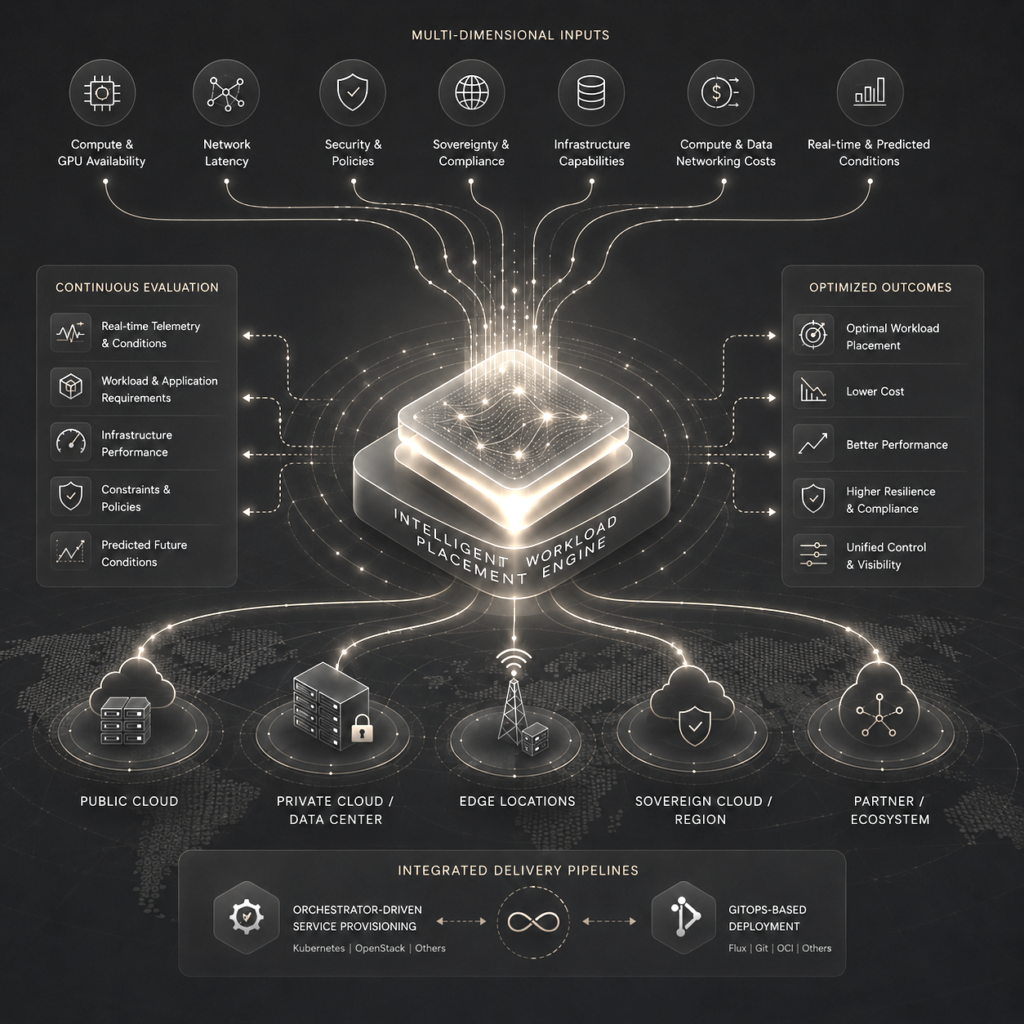
Built on the Arctos Labs ECO platform, this solution brings intelligent workload placement to hybrid, multi-cloud, and edge environments — enabling organizations to run applications where they deliver the greatest business and operational value.
As infrastructure landscapes become increasingly distributed, enterprises need more than traditional orchestration. This solution therefore, introduces advanced workload placement intelligence that continuously aligns application delivery with infrastructure performance, cost efficiency, compliance requirements, and real-time operational conditions.
The platform dynamically evaluates compute availability, GPU requirements, network latency, security policies, sovereignty constraints, infrastructure capabilities, compute, and data networking costs to determine the optimal execution environment for every application component based on the situation at hand as well as predicted future.
Integrated directly into modern application delivery pipelines, the solution supports both orchestrator-driven service provisioning and GitOps-based deployment mechanisms. Native integrations with technologies such as Kubernetes, OpenStack, and Flux enable seamless adaptation across existing enterprise environments and partner ecosystems.
By transforming workload placement into a strategic orchestration capability, organizations can:
- Reduce cloud and infrastructure costs
- Improve application performance and user experience
- Accelerate automation across heterogeneous environments
- Strengthen operational resilience and compliance
- Establish a unified control plane for distributed compute networks
The result is a more adaptive, efficient, and intelligent infrastructure foundation — built for the next generation of cloud, edge, and AI-driven services.
Infrastructure TCO Optimization
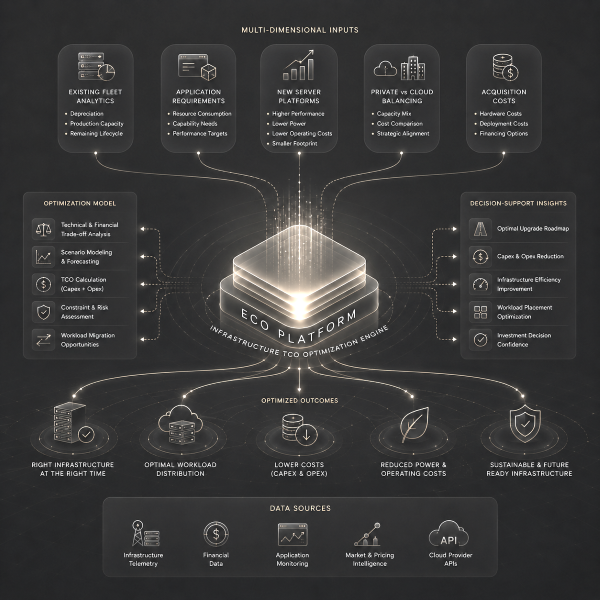
Infrastructure costs are rising rapidly for both service providers and enterprises, making it increasingly challenging to determine the optimal roadmap for infrastructure upgrades.
These decisions depend on several interconnected factors, including:
- Remaining depreciation and production capacity of the existing server fleet
- Application resource consumption and capability requirements
- Improvements offered by new server platforms, such as:
- Reduced physical footprint
- Higher performance
- Lower power consumption
- Lower operating costs
- Balancing capacity between private infrastructure and cloud
- Acquisition costs of new servers
Replacing parts of an infrastructure fleet also creates new opportunities for workload migration and more efficient application placement across the environment. As a result, infrastructure upgrade decisions are inherently complex and multi-dimensional.
Arctos Labs has therefore developed a solution based on the Arctos Labs ECO platform, to address these challenges. The optimization model evaluates the technical and financial trade-offs involved and delivers decision-support insights that help organizations make more informed infrastructure investment decisions, thereby reducing Capex and Opex of infrastructure operations.
Mobile Private Networks
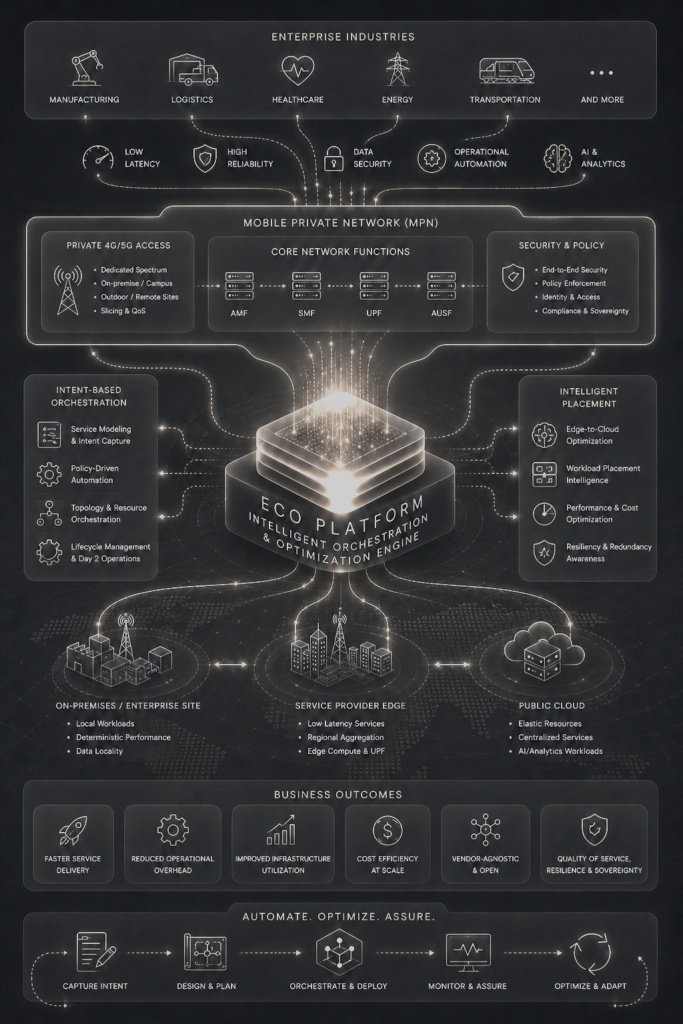
Mobile Private Networks (MPNs) are becoming a key enabler for digital transformation across industries such as manufacturing, logistics, healthcare, energy, and transportation. Enterprises increasingly rely on private 4G/5G connectivity to support latency-sensitive applications, operational automation, AI-driven workloads, and secure industrial communications.
However, current MPN deployments are often delivered as bespoke integration projects, requiring significant engineering effort to address customer-specific requirements related to performance, security, topology, application placement, and lifecycle management. This limits business scalability, and creates operational complexity, for service providers seeking to grow their MPN business efficiently.
To address these challenges, Arctos Labs and Inmanta have jointly developed an intelligent orchestration and optimization solution (based on the Arctos Labs ECO platform) for service providers that address the MPN market. The solution combines intent-based service orchestration with dynamic edge-to-cloud workload placement optimization, enabling automated deployment and lifecycle management across on-premises infrastructure, service provider edge locations, and public cloud environments.
By leveraging distributed cloud infrastructure, automation, and policy-driven orchestration, the solution enables service providers to achieve Quality of Service (QoS), resilience, sovereignty, and cost efficiency whilst maintaining the ability to tailor each deployment to enterprise-specific requirements.
The result is a scalable and vendor-agnostic platform for delivering Mobile Private Networks with significantly reduced operational overhead, faster service delivery, and improved infrastructure utilization.